Entries tagged as ulaanbaatar
asia almaty amusementpark asia2013 aviation azerbaijan baikal beijing belarus berlin border bus capsulehotel caspian ccp censorship childrensday china chinghai cinderella climatechange coach copyright dam disney disneyland dunhuang ecology erenhot erlian fake ferry flying freesoftware greatfirewall guangzhou haikou hainan hohhot hongkong hostel hotel irkutsk journey kazakhstan khorgas kualalumpur language laos lenin listwjanka malaysia metro miradormansion mongolia moscow petropavl poland portbaikal publictransport pyramid qwerty rain rainforest russia sanya seat61 shijingshan stepmania suprememaster terracottawarriors thailand tiananmen ticket train tram transport transsib transsiberian travel travelling trip2011 typhoon ulan-ude ulanude urumqi vegan vegetarian visa warsaw waterpower weather windenergy xian xinjiang yanoda yekaterinburg yining zamyn-uud zensur boten casino ghosttown migrationcard babelfish boluo chinese coffee copycat english freizeitpark googletranslate hallstatt huizhou journalismus luoyang mandarin northwestchina presse pressefreiheit russian tagesschau translation universaltranslator arcade computerhistory magistral museum retro retrogames tankodrom architecture astana baiterek crookedforest forest gryfino khanshatyry migrationpolice nature places
Tuesday, July 5. 2011
Vegetarian food in asia
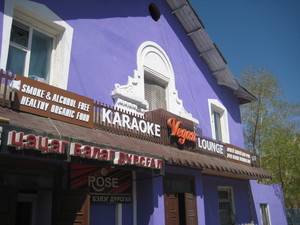 Being a vegetarian was a special challenge on our trip. It was difficult in Russia, where the food plan often enough was reduced to pizza margherita and pancakes. It was even more difficult in China, where the idea of having any food without meat seems to be widely unknown and the choice was often enough reduced to french fries from american fast food companies.
But there was also a surprise: It was absolutely no problem in Mongolia - in sharp contrast to everything I've read before. Traditional mongolian food is very meat-oriented. But Ulaanbaatar has a density of vegetarian and vegan restaurants definitely higher than in Berlin. And even the little border town Zaamin-Üüd has a vegetarian café. Unlike one may expect, I never had the impression that they were primarily focussed to tourists. We even once were in a vegetarian restaurant in Ulaanbaatar that had only a mongolian menu without any english translation.
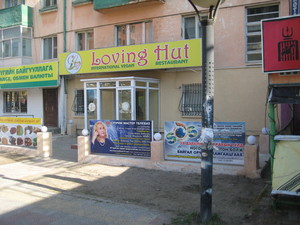 Most of those restaurants seem to be somewhat related to the "spiritual leader" Supreme Master Ching Hai. I don't know that much about her and her group, so I can't judge how problematic I find that (though I'm always sceptical both about leaders and about esoteric groups). Their arguments for veganism are mainly about the greenhouse gas emissions and climate change effects from meat productions, which is absolutely correct, but sadly their stated numbers are just wrong.
Monday, June 13. 2011
From Mongolia to China
 I promised before that I'll present a cheaper way than the international train to get from Ulaanbaatar on to China. But after doing it and all its obstacles, I'm not sure if I'd suggest it any more.
Taking the normal train route on the transmongolian train, the way from Ulaanbaatar to any place in China is quite expensive. Our hostel offered us a train ticket to Jining (濟寧市) or Datong (大同市) for about 140 $. It would've probably been a bit cheaper at the train station, but still it's quite expensive.
Some people in the Hostel told us about a cheap alternative: Taking a local train to the border town Zamyn-Üüd (Замын-Үүд), then going with a Jeep through the border and then using a bus from Erenhot (二连浩特, also called Erlian) to Hohhot (呼和浩特, ᠬᠥᠬᠡᠬᠣᠲᠠ). However, it turned out that it wasn't that simple.
The ticket for the local train to the border costed 10.000 ₮ (about 7 €) for a hardsleeper. But it came with an unplesant surprise: They sell more "hardsleeper" tickets than there are hardsleepers in the train. So having a hardsleeper ticket with a reservation number does not mean that you have your sleeper for sure. For every two sleepers, three tickets are sold. We ended up having the lower beds and we could use them, but regularly people were sitting at the foot end of our sleepers.
 We wanted to go on from Zamyn-Üüd to Erenhot and were confronted with the next unplesant surprise: It was the first of June - international childrens day - and that's a national holiday in Mongolia and the border check is closed. So we were stuck in Zamyn-Üüd for a day longer.
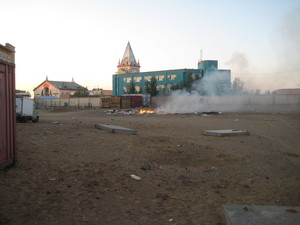
In the evening, we saw the local way of "waste treatment": They just burned it openly. Mongolia is a country which has a lot of problems with air pollution (this is especially a problem of the capital city Ulaanbaatar, but I doubt it's much different there) - it would probably be easy to do this at least a bit better.
The next day, we went on with a jeep to the chinese border town Erenhot. In the end, we payed 10.000 ₮ (about 7 €) per Person plus a small fee at the chinese border I payed with a dollar due to the lack of any chinese or mongolian money.
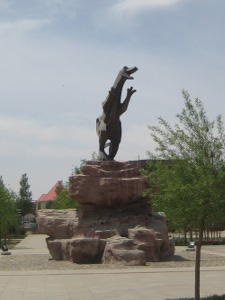
There's not so much to say about Erenhot - the city is very fond of Dinosaurs (because some were found nearby in the Gobi desert) and has a couple of Dinosaur monuments.
 Now with that mysterious bus - I read on several places in the Internet that there exists a bus line between Erenhot and Hohhot, however none of them had anything to say where this bus departs, where you can buy a ticket or where you can find any information at all. It also turned out that communication here was a much bigger problem than thought - I think we didn't meet a single english-speaking person at all. So we ended up using a train to Hohhot, which was also quite cheap and comfortable.
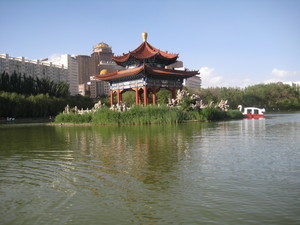
We went to Hohhot not because of anything interesting there, it was just a stop to go on, as there aren't many options for further travelling from Erenhot. It turned out the People's Park there was quite nice and it was our first experience with a bigger chinese city. Afterwards, we went on to the south of China.
Pictures from Zamyn-Üüd
Pictures from Erenhot
Pictures from Hohhot
Tuesday, June 7. 2011
Ulaanbaatar
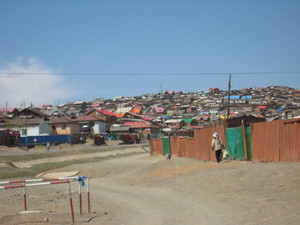 The next stop on our trip was Ulaanbaatar (Улаанбаатар), the capital of Mongolia. Mongolia is the most sparsely populated country in the world and about one third of the population lives in Ulaanbaatar. Large parts of the city consist of ger districts - a ger is a typical mongolian nomadic tent. In those districts, people live very dense either in gers or in very simple wood houses.
Ulaanbaatar is a growing city. The ger districts still grow and in the southern part, a lot of apartment buildings are built. I haven't checked this with other sources, but two people from Ulaanbaatar told me that these constructions are mostly illegal, because they are in a nature reservate where only tourist ger camps are allowed, but corruption allows the constructinos to happen anyway.
The car traffic is very extreme in Ulaanbaatar. Most of the time there's a lot of traffic jam. Many car drivers seem to think that tooting a lot helps in the traffic jam. Very dangerous driving habits are common (this was also the case in russia, but much less extreme).
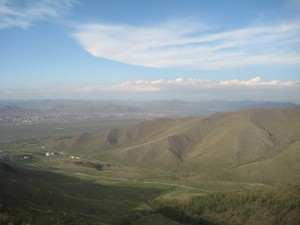 We wanted to visit the Terelj national park near Ulaanbaatar, but that failed because the bus times we got from the Internet were probably wrong (there is no bus at 11:00, no matter what the Internet tells you). Instead, we made a tour to the mountains south of the capital, which was also quite nice and interesting nature.
We visited the Naran Tuul, which is a big market (REALLY big). You can get there just about anything, clothes, bicycles, food, solar cells, satellite dishes, ... We were warned a lot from pickpocketing in Ulaanbaatar in general and especially on the Naran Tuul, but we never had any problems with that.
One evening we visited the Tengis cinema, which I found a quite interesting experience. Movies there run in english with mongolian subtitles. The movie (Thor) was not so good (Pirates of the caribbean sadly wasn't running there yet). The cinema itself had much more atmosphere than the cinemas I'm used to from Germany. Below the cinema is an arcade - some crazy teenagers played a dance dance revolution-alike game in really unbelivable speed.
Pictures from Ulaanbaatar
Pictures from hills / nature near Ulaanbaatar
Saturday, May 28. 2011
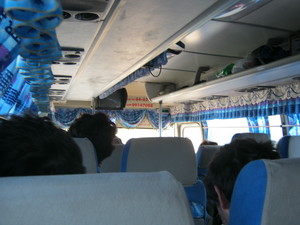
Bus from Ulan-Ude to Ulaanbaatar
 Ulan-Ude (Улан-Удэ) was our last stop in Russia, afterwards we took the bus to Ulaanbaatar (Улаанбаатар), the capital of Mongolia.
I don't know why, but the mongolian part of the transsiberian railway is significantly more expensive than the russian part. The bus is a cheap alternative for the first part and it's also twice as fast (12 hours compared to 24 hours with the train). It costs 1000 rubels (about 25 €). We got the ticket through our hostel, so I can't tell where you can regularly buy it. (For the Mongolia-China part, there's also a cheap alternative, I'll write about that later.)
We started at 7 in the morning in Ulan-Ude. I'm usually a bit uncomfortable with long bus trips, especially if they go on curvy roads. Mongolia has nothing like motorways, so the whole ride goes on bumpy roads through the step.
Arriving at the russian-mongolian border, we had a bad feeling, because our migration card for russia was wrong. We got it at the border to Belarus and we didn't know that it's the migration card for both Belarus and Russia - so we only entered the dates and visa number for Belarus and realized that this was wrong when we entered Russia without a second border check. But it turned out our fear was unneccessary - the staff at the border called a colleague to look at the issue, but shortly afterwards we could go on without any more hassle.
 Right at the border, we already noticed that in Mongolia, english was much more common than in Russia. Unlike on the russian side, some of the mongolian border officers were able to speak english. After the border, we stopped at a restaurant for a while.
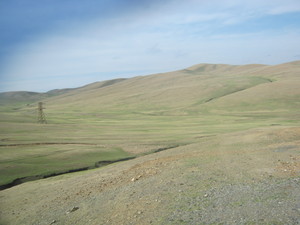
Driving through the mongolian steppe, I felt that the main part of our journey really begins here: The landscape looked very different from everything I am used to and I found it quite exciting. Several times, the bus had to stop or horn for cows crossing the street.
In the evening, we arrived in Ulaanbaatar.
Pictures from Bus trip
Quicksearch
About me
You can find my web page with links to my work as a journalist at https://hboeck.de/.
You may also find my newsletter about climate change and decarbonization technologies interesting.
Hanno Böck
mail: hanno@hboeck.de
Hanno on Mastodon
Impressum

You may also find my newsletter about climate change and decarbonization technologies interesting.
Hanno Böck
mail: hanno@hboeck.de
Hanno on Mastodon
Impressum
Creative Commons

Unless noted otherwise, all content is CC Zero / public domain
