Monday, February 23. 2015
Software Privdog worse than Superfish
 tl;dr There is a software called Privdog. It totally breaks HTTPS security in a similar way as Superfish.
In case you haven't heard it the past days an Adware called Superfish made headlines. It was preinstalled on Lenovo laptops and it is bad: It totally breaks the security of HTTPS connections. The story became bigger when it became clear that a lot of other software packages were using the same technology Komodia with the same security risk.
What Superfish and other tools do is that it intercepts encrypted HTTPS traffic to insert Advertising on webpages. It does so by breaking the HTTPS encryption with a Man-in-the-Middle-attack, which is possible because it installs its own certificate into the operating system.
A number of people gathered in a chatroom and we noted a thread on Hacker News where someone asked whether a tool called PrivDog is like Superfish. PrivDog's functionality is to replace advertising in web pages with it's own advertising "from trusted sources". That by itself already sounds weird even without any security issues.
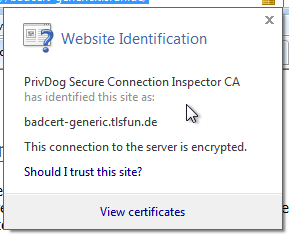
A quick analysis shows that it doesn't have the same flaw as Superfish, but it has another one which arguably is even bigger. While Superfish used the same certificate and key on all hosts PrivDog recreates a key/cert on every installation. However here comes the big flaw: PrivDog will intercept every certificate and replace it with one signed by its root key. And that means also certificates that weren't valid in the first place. It will turn your Browser into one that just accepts every HTTPS certificate out there, whether it's been signed by a certificate authority or not. We're still trying to figure out the details, but it looks pretty bad. (with some trickery you can do something similar on Superfish/Komodia, too)
There are some things that are completely weird. When one surfs to a webpage that has a self-signed certificate (really self-signed, not signed by an unknown CA) it adds another self-signed cert with 512 bit RSA into the root certificate store of Windows. All other certs get replaced by 1024 bit RSA certs signed by a locally created PrivDog CA.
 US-CERT writes: "Adtrustmedia PrivDog is promoted by the Comodo Group, which is an organization that offers SSL certificates and authentication solutions." A variant of PrivDog that is not affected by this issue is shipped with products produced by Comodo (see below). This makes this case especially interesting because Comodo itself is a certificate authority (they had issues before). As ACLU technologist Christopher Soghoian points out on Twitter the founder of PrivDog is the CEO of Comodo. (See this blog post.)
We will try to collect information on this and other simliar software in a Wiki on Github. Discussions also happen on irc.ringoflightning.net #kekmodia.)
Thanks to Filippo, slipstream / raylee and others for all the analysis that has happened on this issue.
Update/Clarification: The dangerous TLS interception behaviour is part of the latest version of PrivDog 3.0.96.0, which can be downloaded from the PrivDog webpage. Comodo Internet Security bundles an earlier version of PrivDog that works with a browser extension, so it is not directly vulnerable to this threat. According to online sources PrivDog 3.0.96.0 was released in December 2014 and changed the TLS interception technology.
Update 2: Privdog published an Advisory.