Tuesday, April 29. 2014
Incomplete Certificate Chains and Transvalid Certificates
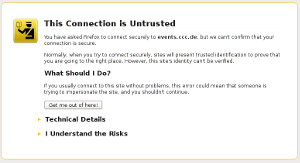 A number of people seem to be confused how to correctly install certificate chains for TLS servers. This happens quite often on HTTPS sites and to avoid having to explain things again and again I thought I'd write up something so I can refer to it. A few days ago flattr.com had a missing certificate chain (fixed now after I reported it) and various pages from the Chaos Computer Club have no certificate chain (not the main page, but several subdomains like events.ccc.de and frab.cccv.de). I've tried countless times to tell someone, but the problem persists. Maybe someone in charge will read this and fix it.
Web browsers ship a list of certificate authorities (CAs) that are allowed to issue certificates for HTTPS websites. The whole system is inherently problematic, but right now that's not the point I want to talk about. Most of the time, people don't get their certificate from one of the root CAs but instead from a subordinate CA. Every CA is allowed to have unlimited numbers of sub CAs.
The correct way of delivering a certificate issued by a sub CA is to deliver both the host certificate and the certificate of the sub CA. This is neccesarry so the browser can check the complete chain from the root to the host. For example if you buy your certificate from RapidSSL then the RapidSSL cert is not in the browser. However, the RapidSSL certificate is signed by GeoTrust and that is in your browser. So if your HTTPS website delivers both its own certificate by RapidSSL and the RapidSSL certificate, the browser can validate the whole chain.
However, and here comes the tricky part: If you forget to deliver the chain certificate you often won't notice. The reason is that browsers cache chain certificates. In our example above if a user first visits a website with a certificate from RapidSSL and the correct chain the browser will already know the RapidSSL certificate. If the user then surfs to a page where the chain is missing the browser will still consider the certificate as valid. Such certificates with missing chain have been called transvalid, I think the term was first used by the EFF for their SSL Observatory.
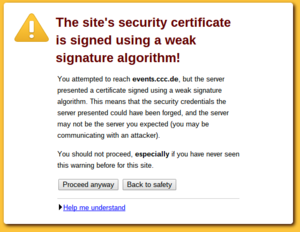
Chromium with bogus error message on a transvalid certificate
So how can you check if you have a transvalid certificate? One way is to use a fresh browser installation without anything cached. If you then surf to a page with a transvalid certificate, you'll get an error message (however, as we've just seen, not neccessarily a meaningful one). An easier way is to use the SSL Test from Qualys. It has a line "Chain issues" and if it shows "None" you're fine. If it shows "Incomplete" then your certificate is most likely transvalid. If it shows anything else you have other things to look after (a common issues is that people unneccesarily send the root certificate, which doesn't cause issues but may make things slower). The Qualys test test will tell you all kinds of other things about your TLS configuration. If it tells you something is insecure you should probably look after that, too.
Thursday, April 24. 2014
Easterhegg talk on TLS
 Last weekend I was at the Easterhegg in Stuttgart, an event organized by the Chaos Computer Club. I had a talk with the title "How broken is TLS?"
This was quite a lucky topic. I submitted the talk back in January, so I had no idea that the Heartbleed bug would turn up and raise the interest that much. However, it also made me rework large parts of the talk, because after Heartbleed I though I had to get a much broader view on the issues. The slides are here as PDF, here as LaTeX and here on Slideshare.
There's also a video recording here (media.ccc.de) and also on Youtube.
I also had a short lightning talk with some thoughs on paperless life, however it's only in German. Slides are here (PDF), here (LaTeX) and here (Slideshare). (It seems there is no video recording, if it appears later I'll add the link.)