Friday, July 29. 2011
Behind the great firewall
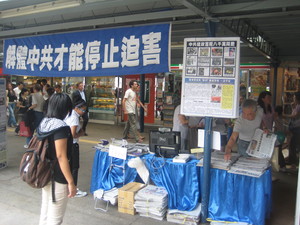 When thinking about China, probably many people associate this with censorship.
On my trip, I had the chance to see the infamous great firewall from the inside. I haven't done any deeper analysis, but I'll share some thinkgs I've observed. A couple of famous sites (for example Twitter, Flickr) are blocked. Contrary to what many people may believe, webpages that are often associated with Warez (Rapidshare, Pirate Bay) were also blocked. The situation with Wikipedia was mixed. Most of the time, I could read the texts on Wikipedia, but access to the image servers was blocked. At the end of our trip, I couldn't access Wikipedia any more.
I encountered no blocks on less famous sites, although I regularly surf sites that could be labelled politically controversial. Though this probably doesn't tell much, except that the chinese authorities are not very interested in blocking european websites.
Interesting may be that the blocking works on an IP level. DNS resolution of blocked sites still works, but you cannot ping the IPs. I haven't extensively tried to circumvent the censorship, as I had no pressing need for it. The only thing I tried was an SSH tunnel, but that usually wasn't possible as the connection never was fast and reliable enough for a stable SSH session.
Most Hotels and Hostels provide Internet access - but most of them by cable. Usually, in other countries today this is done via wireless lan. My theory on that is that a cable-based Internet access makes it easier to log activity associated to a specific person (you always have to show your passport when you check into a Hotel). But still, we had anonymous Internet access (both wireless and cable) at a few places.
Another thing I'd like to mention is what the (non-technical) censorship did with me. I knew that in China people cannot just write a blog, they need some kind of license for it. I was very unsure what this means for me as a forein traveller. I came to the conclusion that I likely won't get any trouble if I just write about my trip without touching any controversial topics. Although I hadn't planned to write anything, this was always in my mind and probably influenced my writings. There was one time where I self-censored myself. In the entry about Hong Kong, I originally had this part, which I removed before publishing:
Most notably it is a place where free speech is possible to a much higher degree than in mainland China. This makes it a very important place for political discussion about China in general. We saw chinese dissident groups that had their information tables and spread leaflets around the Kowloon harbour.
Not much and I luckily have the opportunity to publish it now.
Friday, July 15. 2011
Visa
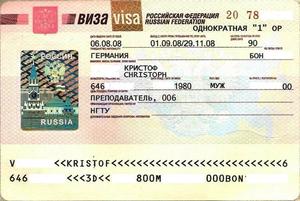 For our trip, we needed a couple of visa. I haven't applied myself for a visa any time before, so this was quite new to me. This was the most troublesome part of our travel preparations.
What I learned about getting visa:
- Every country has different rules for visa.
- You cannot apply for several visa at once - they take your passport. That means you have to add all the waiting times and cannot apply for more than one at once (this may seem trivial if you know the procedure, but I didn't).
- The information on the consulates webpages is often incomplete or inaccurate. (For example, if you have a 30 day visa: Does that mean 30 days starting from your entry to the country? Or 30 days starting from a fixed date you have to know in advance? Pretty relevant if you plan your trip.)
- If you phone a consulate, they won't answer. If you email a consulate, they won't answer.
- You cannot expect that anyone in the consulate is able to speak to you in a language you understand.
- You cannot expect that information you got from people in the consulate is correct.
- Usually, the best way to get information is searching the internet for people who have done the same thing before. There are specialized companies that arrange your visa, but the information you get from them is also often inaccurate.
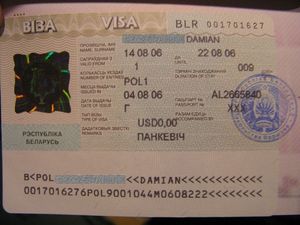 In the end, we applied for 6 different visa (Russia, Mongolia, Belarus, China, Kazakhstan, Azerbaijan), although we didn't use them all in the end (see previous blog entry).
The most difficult part was the russian one. That was, in the end, the reason we couldn't make the trip the way we wanted to (taking the transsiberian train for both directions with stops). They have a kind of bizzare regulation regarding invitations: You need an invitation to apply for a russian tourist visa. This has evolved a market for agencies that arrange invitations. That means you pay them that they do a fake booking in a hotel you will never see in reality and get an invitation from them.
Another anecdote: When asking for the "two-way"-problem in the embassy, they gave us a contact to a travel agency that will help us. This travel agency suggested we could get two passports and thus apply for two visa - that would've been illegal according to russian law. I had no intention in seeing a russian jail from inside, so I refused to choose that option.
You see, it's a pretty complex issue. But there's one thing one should mention, too: It's not the russian (or other countries) authorities that are to blame here. Russia is very willing to relax its visa rules. They even suggested several times to abbadon the visa requirement for EU citizens at all. They just have one requirement: The regulation should be relaxed for their citizens, too. Everything I've heared suggests that russians trying to get a visa for Germany and other EU countries face more difficulties than the other way round. It's the EU that is blocking here.
If you want visa regulations to be relaxed, you'd better not only blame other countries regulations. You should also ask how regulation is the other way round. Looking at the current political debate in the EU, I don't have much hope that the situation will improve soon.
(the pictures are from Wikimedia Commons here (Russia) and here (Belarus) and are public domain)

