Saturday, March 24. 2007
Linux-Infoday in Augsburg
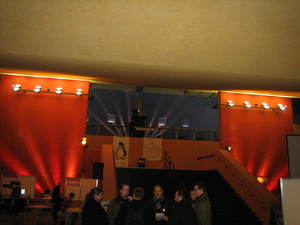
I'm here at the Linux-Infotag 2007 from the linux user group Augsburg. It's a small and familiar event. Seems that there are a lot of freifunk-people (free wlan networks) in augsburg. On my way to Augsburg, fitting to the topic I had to switch trains in the linux-town Treuchtlingen.
I had a talk about 3D-Desktops (Linux 3D-Slides, OpenDocument). Will stay for some more hours.
It's nice to see more local linux events evolving.
Update: Some pictures from the LIT 2007
I had a talk about 3D-Desktops (Linux 3D-Slides, OpenDocument). Will stay for some more hours.
It's nice to see more local linux events evolving.
Update: Some pictures from the LIT 2007
Posted by Hanno Böck
in Computer culture, Copyright, English, Gentoo, Life, Linux
at
12:58
| Comments (3)
| Trackbacks (0)
Wednesday, March 21. 2007
OpenStreetMap Slides
Hatte ich vergessen, wollte ich noch posten: Hab vor zwei Wochen bei der LUG Backnang eine Kurzeinführung zu OpenStreetmap gegeben, die Slides dazu gibt's wie üblich hier.
Tuesday, March 20. 2007
Driver for laptop cardreader
My laptop (Samsung P35) has an internal card reader (SD and MemoryStick) done by Ricoh. Several other laptops have this device. It's internally connected as a pcmcia-device and shows up as RICOH Bay1Controller on pccardctl ident.
For years now there was no way to get this thing running in linux, which stopped me from doing projects like having a crypto-key on a small SD-Card and insert that on boot. Now, finally someone did the job and reverse engineered the device: sdricohcs
In my first small tests, I could already download some photos from my digital camera card. No problems so far. Now, the only thing I'm really missing with linux on my laptop left is TV-Out (works with ati binary drivers, but they are unstable like hell). I heared some Xorg-devs are already working on it, so maybe I'll soon announce the »nearby 100%« support for Linux on Samsung P30/P35.
For years now there was no way to get this thing running in linux, which stopped me from doing projects like having a crypto-key on a small SD-Card and insert that on boot. Now, finally someone did the job and reverse engineered the device: sdricohcs
In my first small tests, I could already download some photos from my digital camera card. No problems so far. Now, the only thing I'm really missing with linux on my laptop left is TV-Out (works with ati binary drivers, but they are unstable like hell). I heared some Xorg-devs are already working on it, so maybe I'll soon announce the »nearby 100%« support for Linux on Samsung P30/P35.
Wednesday, March 14. 2007
dmidecode - useful tool
I wrote a few days ago (only in german) about my requests to the 1und1-support for information about the hardware of our rootserver (to complete the PCI ID database).
Now, after their first reply, I now got another mail with more useful information: They pointed me to the tool dmidecode, which can find lot's of information about the BIOS and the motherboard. Didn't know that before, it's also useful to find out the BIOS version on a running system.
Now, this looks like what I was looking for:
Handle 0x0002, DMI type 2, 8 bytes
Base Board Information
Manufacturer: FUJITSU SIEMENS
Product Name: D2030-A1
Now, after their first reply, I now got another mail with more useful information: They pointed me to the tool dmidecode, which can find lot's of information about the BIOS and the motherboard. Didn't know that before, it's also useful to find out the BIOS version on a running system.
Now, this looks like what I was looking for:
Handle 0x0002, DMI type 2, 8 bytes
Base Board Information
Manufacturer: FUJITSU SIEMENS
Product Name: D2030-A1
Saturday, March 10. 2007
Kompetenz bei 1und1
Wie ich ja gestern schrieb, bin ich gerade bemüht, die Device ID-Datenbanken von Linux zu ergänzen. Unser 1und1-Rootserver antwortet auf ein lspci -v mit mehreren Zeilen der Form:
Subsystem: Fujitsu Siemens Computer GmbH Unknown device 1099
Weswegen ich mich bemühte, durch folgende Nachricht an den Support Auskunft über das verwendete Board zu erhalten:
Ich würde gerne die Hardwaredaten unseres Servers vollständig in der Linux PCI ID Datenbank erfasst haben ( http://pciids.sf.net ).
Dafür benötige ich die genaue Produktbezeichnung des in unserem Server verwendeten Motherboards. Es handelt sich, soweit ich sehen kann, um ein Fujitsu-Siemens-Modell.
Beantwortet wurde dies mit:
wenn Sie den Befehl lspci -v per SSH ausführen, sollten Ihnen dazu weitere Informationen angezeigt werden.
Ich erspare mir glaube ich jeden weiteren Kommentar.
(eine gleichzeitig abgeschickte Anfrage an Hetzner wurde übrigens ohne Probleme beantwortet)
Subsystem: Fujitsu Siemens Computer GmbH Unknown device 1099
Weswegen ich mich bemühte, durch folgende Nachricht an den Support Auskunft über das verwendete Board zu erhalten:
Ich würde gerne die Hardwaredaten unseres Servers vollständig in der Linux PCI ID Datenbank erfasst haben ( http://pciids.sf.net ).
Dafür benötige ich die genaue Produktbezeichnung des in unserem Server verwendeten Motherboards. Es handelt sich, soweit ich sehen kann, um ein Fujitsu-Siemens-Modell.
Beantwortet wurde dies mit:
wenn Sie den Befehl lspci -v per SSH ausführen, sollten Ihnen dazu weitere Informationen angezeigt werden.
Ich erspare mir glaube ich jeden weiteren Kommentar.
(eine gleichzeitig abgeschickte Anfrage an Hetzner wurde übrigens ohne Probleme beantwortet)
Browser-Spielchen
Ich bin ja bekennender KDE und Konqueror-Fan, aber ein zentrales Feature fehlt: Das DHTML-Lemmings läuft hier nicht, weswegen man Firefox bemühen muss.
Escapa! ist auch sehr nett und läuft auch im Konqueror.
Posted by Hanno Böck
in Computer culture, Linux, Retro Games
at
02:47
| Comments (2)
| Trackback (1)
Friday, March 9. 2007
Small things to help free software: Device IDs
A thing that people often ask in the free software world: I can't program but I want to help out somewhere.
Theres one thing that's very simple to do for everyone using Linux. We have two tools called lspci and lsusb that look on the pci/usb-bus for installed devices. Each device has an ID, consisting of a vendor ID and a product ID. Everyone can check the own hardware if everything is detectet. For lspci, first run update-pciids, then lspci -v. Each »Unknown« represents some ID that's not in pci.ids. Report the exact device model name to the interface on http://pciids.sourceforge.net/.
For lsusb, run update-usbids and attach all usb devices you can find. lsusb doesn't show Unknown, if after a device number there's only a vendor name, then the ID is unknown. The usb.ids database is much more incomplete than the pci database. They don't have such a fancy interface as pciids, just send it to the current maintainer (listed in the file usually at /usr/share/misc/usb.ids or /usr/share/usb.ids).
Theres one thing that's very simple to do for everyone using Linux. We have two tools called lspci and lsusb that look on the pci/usb-bus for installed devices. Each device has an ID, consisting of a vendor ID and a product ID. Everyone can check the own hardware if everything is detectet. For lspci, first run update-pciids, then lspci -v. Each »Unknown« represents some ID that's not in pci.ids. Report the exact device model name to the interface on http://pciids.sourceforge.net/.
For lsusb, run update-usbids and attach all usb devices you can find. lsusb doesn't show Unknown, if after a device number there's only a vendor name, then the ID is unknown. The usb.ids database is much more incomplete than the pci database. They don't have such a fancy interface as pciids, just send it to the current maintainer (listed in the file usually at /usr/share/misc/usb.ids or /usr/share/usb.ids).
Posted by Hanno Böck
in Code, Computer culture, English, Gentoo, Linux
at
00:23
| Comments (2)
| Trackback (1)
Sunday, March 4. 2007
Erster Tag Chemnitzer Linux-Tage
Sehr nett fand ich heute den Vortrag »Linux und Freie Software richtig bewerben« von Meike Reichle. Einige eigentlich zwar selbstverständliche, aber dennoch sinnig mal auszuführende Anmerkungen zu typischen Fehlern a la »Umlaute brauch ich nicht« (was beim Benutzer als »Linux hat keine Umlaute« ankommt).
Die gerade noch laufende Linux-Nacht fiel etwas unangenehm auf durch eine seltsame "wer auf's Klo will, muss 5 EUR hinterlegen und darf nur 15 min brauchen«-Regelung, aufgrund einer im selben Gebäude stattfindenden Party auf. Im Messegebäude begrüßte einen ein Bücherstand mit einem Windows-System im Hintergrund auf dem Beamer.
Ansonsten isses aber ne gelungene Veranstaltung. Hab heute abend noch eine spontane Kurzvorführung von OpenStreetMap gemacht.
Posted by Hanno Böck
in Computer culture, Copyright, Life, Linux
at
00:14
| Comments (3)
| Trackbacks (0)
Friday, March 2. 2007
Auf nach Chemnitz
In größerer Gruppe werden wir morgen die Chemnitzer Linux-Tage entern. Wie das so ist, Streß kurz vor dem losfahren, ist auch alles dabei, Navi, Digikam, PGP-Keysigning-Liste etc. Bebilderter Report folgt sicher.
Thursday, March 1. 2007
Early look at free nvidia driver

Binary drivers are imho a hughe problem for free software. Nvidia, leading graphics company, has produced binary linux drivers for a long time and there was no way to get free software 3D-support on their cards.A group of people is working at the moment on a free nvidia driver, the project is called nouveau. I now had a chance to test the nouveau driver on a nvidia card (nv43). It doesn't do much at the moment, but at least it runs glxgears almost smooth.
It's nice to see development on that front. We made a small video of glxgears running on nouveau. Oh, for all those who can't play theora, I put it up on youtube (but seriously, was just curious how youtube works and if it accepts theora).
Some experimental nouveau-ebuilds, maintained by pq from the nouveau-project, are here:
svn co https://svn.hboeck.de/nouveau-overlay
(Page 1 of 1, totaling 10 entries)