Tuesday, August 29. 2006
Webmontag der Dritte, Vortrag »Zentrale vs. dezentrale Webservices«
Heute (naja, gestern) wieder Webmontag in Karlsruhe im Kubik. Es gab drei Vorträge, einer davon von mir (ich hab das Gefühl, dass meine Vortragsroutine langsam besser wird), Slides wie immer als OpenDocument und als PDF. Die Leute waren heute sehr diskutierfreudig, weswegen es deutlich länger als geplant ging. Zwar musste natürlich irgendwann der Einwand »Businessmodel« kommen (ich glaub da schreib ich mal was längeres zu), aber insgesamt war's ganz in Ordnung.
Anschließend MNT über Simple Sharing Extensions, scheint ne interessante Sache zu sein, die evtl. einige der Probleme lösen könnte, über die ich mir auch schon Gedanken gemacht hab (wie verknüpf ich indizierte RSS-Elemente wieder mit ihrem Ursprung). Achja: Es ist zwar von Microsoft, aber die Dokumente als CC veröffentlicht.
Problem scheint im Moment zu sein, dass es keine Software dafür gibt.
Dritter und letzter Oliver Gassner, der sich am Begriff (oder, wie er meinte, nicht-Begriff) Web 2.0 störte, weil dieser völlig undefinierbar und unbrauchbar sei. Ich würde jetzt mal wagen, dem vorsichtig zu widersprechen, dass man schon grob einkreisen kann, worum es sich bei Web 2.0 dreht: Im weitesten Sinne offene Kommunikation mit Interaktionsmöglichkeiten, die die Möglichkeit zum reinen Lesen/Konsumieren bietet, aber dem Nutzer auf Wunsch irgendeine Art von Interaktion ermöglicht. Zwar hat Oliver einige Dinge mehr noch erwähnt, die angeblich Web 2.0 seien (Pay per click, kontextsensitive Werbung) und damit nix zu tun haben, ich fand aber unklar, wieso er die jetzt zu Web 2.0 mitzählen will. Alles, was ich allgemein drunter verstehen würde, hat schon dieses Interaktionsmerkmal zu eigen.
Im Anschluss beim Socialing hatten wir noch ne kleine Runde über CAcert (nächstes Mal gibt's glaub von mir dazu n ausführlichen Vortrag, scheint ja doch großes Interesse zu wecken) und eine etwas hitzigere Diskussion über Linux auf dem Desktop. Dabei hab ich gemerkt, dass ich mir in jüngerer Zeit angewöhnt hab, auch die Linux 9.0-Fraktion freundlich zu behandeln.
Anschließend MNT über Simple Sharing Extensions, scheint ne interessante Sache zu sein, die evtl. einige der Probleme lösen könnte, über die ich mir auch schon Gedanken gemacht hab (wie verknüpf ich indizierte RSS-Elemente wieder mit ihrem Ursprung). Achja: Es ist zwar von Microsoft, aber die Dokumente als CC veröffentlicht.
Problem scheint im Moment zu sein, dass es keine Software dafür gibt.
Dritter und letzter Oliver Gassner, der sich am Begriff (oder, wie er meinte, nicht-Begriff) Web 2.0 störte, weil dieser völlig undefinierbar und unbrauchbar sei. Ich würde jetzt mal wagen, dem vorsichtig zu widersprechen, dass man schon grob einkreisen kann, worum es sich bei Web 2.0 dreht: Im weitesten Sinne offene Kommunikation mit Interaktionsmöglichkeiten, die die Möglichkeit zum reinen Lesen/Konsumieren bietet, aber dem Nutzer auf Wunsch irgendeine Art von Interaktion ermöglicht. Zwar hat Oliver einige Dinge mehr noch erwähnt, die angeblich Web 2.0 seien (Pay per click, kontextsensitive Werbung) und damit nix zu tun haben, ich fand aber unklar, wieso er die jetzt zu Web 2.0 mitzählen will. Alles, was ich allgemein drunter verstehen würde, hat schon dieses Interaktionsmerkmal zu eigen.
Im Anschluss beim Socialing hatten wir noch ne kleine Runde über CAcert (nächstes Mal gibt's glaub von mir dazu n ausführlichen Vortrag, scheint ja doch großes Interesse zu wecken) und eine etwas hitzigere Diskussion über Linux auf dem Desktop. Dabei hab ich gemerkt, dass ich mir in jüngerer Zeit angewöhnt hab, auch die Linux 9.0-Fraktion freundlich zu behandeln.
Posted by Hanno Böck
in Code, Computer culture, Linux, Webdesign
at
00:55
| Comments (4)
| Trackbacks (0)
Sunday, August 27. 2006
Free Software and marketing
This friday, there were two driver releases for linux graphics hardware. A new proprietary driver from nvidia and a new free driver for ati cards.
The release of the new nvidia driver was spread over all major news-pages. It's main new feature was the support of Xorg 7.1 just three months after it's release and about five months after the first release candidate. It still doesn't support the main new feature of Xorg 7.1, which is AIGLX. I couldn't find the release of the new free ati driver mentioned anywhere (even on linux news-pages) and probably even wouldn't have noticed if I wouldn't read the xorg-mailinglist. The new ati driver has much improved support for r300 and above chips, which is very important for the future development of 3D-desktops like compiz.
Now, the reason why this happens is probably that nvidia put out a colorful press release when they update their drivers. One could say that it's bad journalism from those news pages (especially if they are linux related) that if they get press releases from companies, they always post news, but they don't do so for rarely announced free releases. But news writers are lazy, if they get some ready-to-publish press release, they'll more likely take it than grabbing some announcement from some developers mailinglist. The problem from many free software projects is that their publicity sucks.
The work done by the xorg-developers to the ati-drivers is great. But I still meet people that even don't know the free drivers support anything above 9200. I never read big announcements on news pages about »free ati driver now supporting new card xy«. Now, if you have a look at the xorg-page, it doesn't even have release announcements. It looks boring. We know that xorg is cool, that it has wobbly windows and such, that development is happening. But looking at the webpage, it much more looks like xfree86.
This problem is not just related to xorg, it's just that I noticed this fact the last days (two driver-releases, only one noted). Same thing was e. g. with ffmpeg supporting h264 for a long time and then I read that some »I-forgot-their-name«-company said they'll bring a commercial h264-codec to linux. Or that about a week after ffmpeg supported wmv9 (also rarely noted by the public), real software said they want to bring wmv-support to linux. There's so much great stuff going on in free software development that would deserve more publicity.
Oh, and for a last note, Lars also has a nice example how not to do it.
The release of the new nvidia driver was spread over all major news-pages. It's main new feature was the support of Xorg 7.1 just three months after it's release and about five months after the first release candidate. It still doesn't support the main new feature of Xorg 7.1, which is AIGLX. I couldn't find the release of the new free ati driver mentioned anywhere (even on linux news-pages) and probably even wouldn't have noticed if I wouldn't read the xorg-mailinglist. The new ati driver has much improved support for r300 and above chips, which is very important for the future development of 3D-desktops like compiz.
Now, the reason why this happens is probably that nvidia put out a colorful press release when they update their drivers. One could say that it's bad journalism from those news pages (especially if they are linux related) that if they get press releases from companies, they always post news, but they don't do so for rarely announced free releases. But news writers are lazy, if they get some ready-to-publish press release, they'll more likely take it than grabbing some announcement from some developers mailinglist. The problem from many free software projects is that their publicity sucks.
The work done by the xorg-developers to the ati-drivers is great. But I still meet people that even don't know the free drivers support anything above 9200. I never read big announcements on news pages about »free ati driver now supporting new card xy«. Now, if you have a look at the xorg-page, it doesn't even have release announcements. It looks boring. We know that xorg is cool, that it has wobbly windows and such, that development is happening. But looking at the webpage, it much more looks like xfree86.
This problem is not just related to xorg, it's just that I noticed this fact the last days (two driver-releases, only one noted). Same thing was e. g. with ffmpeg supporting h264 for a long time and then I read that some »I-forgot-their-name«-company said they'll bring a commercial h264-codec to linux. Or that about a week after ffmpeg supported wmv9 (also rarely noted by the public), real software said they want to bring wmv-support to linux. There's so much great stuff going on in free software development that would deserve more publicity.
Oh, and for a last note, Lars also has a nice example how not to do it.
Monday, August 14. 2006
My next laptop
From time to time I recently thought that the day I need to think about a new laptop might not be that far away. It's probably still a year or so I'll use my current one, but I already have my eye a bit on current models and spent some thoughts on it. As always, I think it'll not be a »take the model fitting all my needs, it'll be a »take the lesser evil«.
Some things I'd love to have in my new laptop, if you're working for a laptop-company, maybe you could tell your hardware designers about this post ;-)
1. Make it lightweight.
I carry it around very often. < 2 kg would be fine, 1 kg would be great.
2. No internal CD/DVD.
Recently someone said to me: »Why don't they build laptops without optical drives?« I thought a bit about it and think he was totally right. The CD/DVD-drive is probably one of the most heavy parts of a laptop that could be removed. I (and I think many others) use it very rarely and would have no problem to use an external one when I'm at home. Just deliver a »get external USB-drive cheap«-coupon with it.
3. Ergonomics and usability of keyboard and touchpad.
Okay, I've seen things like putting the </>-Key on the right side much too often. Hey, have you ever thought that people search their keys where they're used to be? I know you can't place a common keyboard on a laptop, but who the hell says that you can place keys whereever you want? I'd like to have the basic part (that is all letters, numbers and char-keys around them) not crippled.
Mouse/touchpad: Just if someone dares to suggest me buying something from that company with the fruit-logo. As I said above, I'm carrying my laptop around very often (that's why I have a laptop). And I want to use it when driving in a train, sitting at some hackers-event I hitchhiked to or things like that. That means I want to use it at places I don't have an external mouse with me. Thus the touchpad should be usable. I'm usually used to have a middle-mouse-button. Now, why have they vanished from most of todays laptops? There were mouse-wheels on laptops some years ago, but today they're very rare (my current one, Samsung P30 has none, although the earlier model, X10, had one).
4. Linux and drivers.
Make a fully Linux-compatible laptop. Hell, is that so hard? I asked around at the linuxtag once, where many laptop-vendors had booths. None could advertise me a model which they claimed »fully linux-supported«.
And with »fully linux-supported« I mean all features and free drivers. No »yeah, the graphics are supported, but 3D is a bit slow and no TV-Out«, no internal »WinModem« that has a free-of-charge-driver supporting 14.4k and a xx €-driver for full-speed, no »we once had a driver for 2.4-kernels, but stopped developing it«. I want to be able to use every device built into that thing I've payed for.
5. Sell it cheaper without windows.
I don't want to pay for things I don't use.
5. Many USB-Ports.
Hey, everything today is USB. USB-sticks, USB-bluetooth-adapter, USB-mouse, USB-keyboard, USB-tabled, USB-camera, USB-joypad, USB-HD. My current model has only 2. I'd need at least 6, better 8.
6. Put some quality speakers in it.
I've heard laptops that were completely unusable for watching movies because their speakers were so bad (my current ones are quite okay).
7. I hope I can still buy something without TPM then.
Could probably think of much more.
Some things I'd love to have in my new laptop, if you're working for a laptop-company, maybe you could tell your hardware designers about this post ;-)
1. Make it lightweight.
I carry it around very often. < 2 kg would be fine, 1 kg would be great.
2. No internal CD/DVD.
Recently someone said to me: »Why don't they build laptops without optical drives?« I thought a bit about it and think he was totally right. The CD/DVD-drive is probably one of the most heavy parts of a laptop that could be removed. I (and I think many others) use it very rarely and would have no problem to use an external one when I'm at home. Just deliver a »get external USB-drive cheap«-coupon with it.
3. Ergonomics and usability of keyboard and touchpad.
Okay, I've seen things like putting the </>-Key on the right side much too often. Hey, have you ever thought that people search their keys where they're used to be? I know you can't place a common keyboard on a laptop, but who the hell says that you can place keys whereever you want? I'd like to have the basic part (that is all letters, numbers and char-keys around them) not crippled.
Mouse/touchpad: Just if someone dares to suggest me buying something from that company with the fruit-logo. As I said above, I'm carrying my laptop around very often (that's why I have a laptop). And I want to use it when driving in a train, sitting at some hackers-event I hitchhiked to or things like that. That means I want to use it at places I don't have an external mouse with me. Thus the touchpad should be usable. I'm usually used to have a middle-mouse-button. Now, why have they vanished from most of todays laptops? There were mouse-wheels on laptops some years ago, but today they're very rare (my current one, Samsung P30 has none, although the earlier model, X10, had one).
4. Linux and drivers.
Make a fully Linux-compatible laptop. Hell, is that so hard? I asked around at the linuxtag once, where many laptop-vendors had booths. None could advertise me a model which they claimed »fully linux-supported«.
And with »fully linux-supported« I mean all features and free drivers. No »yeah, the graphics are supported, but 3D is a bit slow and no TV-Out«, no internal »WinModem« that has a free-of-charge-driver supporting 14.4k and a xx €-driver for full-speed, no »we once had a driver for 2.4-kernels, but stopped developing it«. I want to be able to use every device built into that thing I've payed for.
5. Sell it cheaper without windows.
I don't want to pay for things I don't use.
5. Many USB-Ports.
Hey, everything today is USB. USB-sticks, USB-bluetooth-adapter, USB-mouse, USB-keyboard, USB-tabled, USB-camera, USB-joypad, USB-HD. My current model has only 2. I'd need at least 6, better 8.
6. Put some quality speakers in it.
I've heard laptops that were completely unusable for watching movies because their speakers were so bad (my current ones are quite okay).
7. I hope I can still buy something without TPM then.
Could probably think of much more.
Thursday, August 10. 2006
Playing youtube videos with free software
If you've been surfing around the internet lately, you probably noticed that videos are often provided via some strange flash-players. That's ugly, because a) you can't download them and b) you need the proprietary flash-plugin. If you have a deeper look into how those flash-stuff works, it's basically just a small applet getting a flv-file (Flash Video) via http. Now, in theory you can use some sniffer like wireshark to get the url or directly the full video. But you'd still need to run the applet in some way.
But there are better solutions, at least for the most common service youtube (google video has recently added download links, so that's fine for now). The URLs are standardized and can be extracted from the page source.
Konqueror users can get this small extension, which will add a context menu for youtube under right click -> actions.Firefox-users can get VideoDownloader (which supports much more video platforms).
As Eiferer noted in the comments, VideoDownloader is SpyWare, so I'd suggest you don't use that. There's another one, based on greasemonkey, here, and, a platform independent bookmarklet here.
Now, playing flv is supported by ffmpeg, so all common linux-players should be able to play them. Thus you can get those videos and play them without using any proprietary software.
But there are better solutions, at least for the most common service youtube (google video has recently added download links, so that's fine for now). The URLs are standardized and can be extracted from the page source.
Konqueror users can get this small extension, which will add a context menu for youtube under right click -> actions.
As Eiferer noted in the comments, VideoDownloader is SpyWare, so I'd suggest you don't use that. There's another one, based on greasemonkey, here, and, a platform independent bookmarklet here.
Now, playing flv is supported by ffmpeg, so all common linux-players should be able to play them. Thus you can get those videos and play them without using any proprietary software.
Monday, August 7. 2006
Getting rid of proprietary software: VC-1/WMV9 in ffmpeg
Thanks to Kostya, ffmpeg now supports the VC-1 codec, which is also used in Microsofts WMV9-format.
In the past, for Linux-users it was only possible to play those videos with win32codecs, which use proprietary windows-dlls and don't work on non-x86-platforms. With this improvement, one of the most common multimedia-formats unsupported by free software can now be played with all major free players (as ffmpeg is used by vlc, xine, mplayer, totem and many others).
Congrats to the ffmpeg-guys. The easiest way to get stuff playing is getting mplayer from svn (I used the mplayer-svn-ebuild from this Multimedia Overlay with some small modifications).
(via Breaking Eggs and making Omelettes)
In the past, for Linux-users it was only possible to play those videos with win32codecs, which use proprietary windows-dlls and don't work on non-x86-platforms. With this improvement, one of the most common multimedia-formats unsupported by free software can now be played with all major free players (as ffmpeg is used by vlc, xine, mplayer, totem and many others).
Congrats to the ffmpeg-guys. The easiest way to get stuff playing is getting mplayer from svn (I used the mplayer-svn-ebuild from this Multimedia Overlay with some small modifications).
(via Breaking Eggs and making Omelettes)
Thursday, August 3. 2006
PC Magazin LINUX
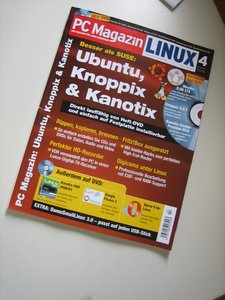 Das PC Magazin LINUX 4/2006 gibt's seit kurzem an jedem gut sortierten Kiosk.
Das ist insofern hier erwähnenswert, weil einige der enthaltenen Artikel mein Werk sind, darunter einer über AIGLX und ein Bericht über den Linuxtag, außerdem Teile der Tipps und Tricks zu Multimedia & Office, sowie System & Konfiguration.
(Page 1 of 1, totaling 6 entries)